
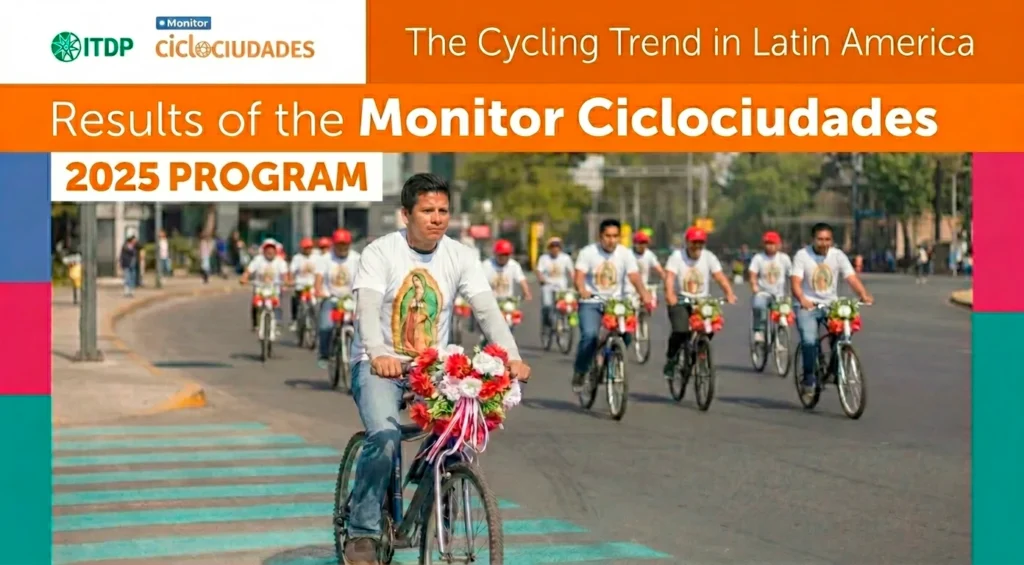
Talking about cycling mobility in Latin America today means leaving improvisation behind and, instead, starting to take data seriously. Consequently, it is no longer just about questioning the viability of bicycles; rather, it is about defining how to integrate them safely and functionally into urban space. In this context, the Monitor Ciclociudades 2025 Program (Cyclocities Monitor 2025), coordinated by the Institute for Transportation and Development Policy (ITDP), becomes a key tool to understand what is really happening in urban areas.
This initiative was launched in 2013 as the Ranking Ciclociudades (Cyclocities Ranking), initially focused on measuring and comparing progress among Mexican cities. As the project evolved, it revealed both strengths and limitations. Furthermore, the experience gained, combined with the urban diversity of Latin America, led to a profound transformation. By 2025, the change is not merely cosmetic. Instead, the focus shifts from rewarding positions in a ranking to examining processes, public policy decisions, and sustained results.
From Ranking to Urban Monitoring
The program moves away from the logic of competition and, instead, embraces continuous monitoring. Indeed, ITDP promoted this evolution after identifying that methodological variations between editions made it difficult to compare real progress. As a result, the new version maintains stable criteria over time, which allows for analyzing trends, detecting stagnation, and recognizing gradual improvements.
Moreover, the initiative expands its scope to cities across different Latin American countries. This openness responds to a shared reality: the challenges of cycling mobility tend to repeat themselves with similar nuances, regardless of the national context. By observing the regional landscape, cities can learn from one another without the need to replicate models that do not fit their own reality.
How the Monitor Ciclociudades 2025 Program Works
In collaboration with local governments and civil society organizations, this framework is built around three key elements that provide a multidimensional view of cycling mobility. The first element is a survey completed by government authorities, structured around three areas and twenty-five indicators that assess cycling infrastructure, education and promotion, and monitoring and governance.
Another key element is the collaborative video mapping of cycling infrastructure. By engaging community groups and using open platforms, the actual condition of the streets is documented at street level. This visual evidence is essential for contrasting official reports with the real challenges cyclists face in their daily commutes.
Finally, the third element involves surveys of bicycle users and questionnaires for citizen groups. In the 2025 edition, more than 2,300 cyclists and dozens of organizations from different countries participated. As a result, this information provides a direct reading of safety perception, travel habits, and the everyday use of cycling infrastructure.
Bike Infrastructure And Road Space Quality Play a Central Role In Shaping Uban Mobility
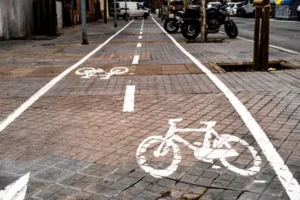
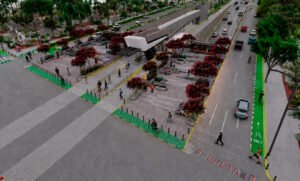
A key insight from the study is that longer networks do not necessarily guarantee higher quality. Although the cities examined feature more than 3,100 miles of bike infrastructure, only about 30 percent meet optimal design criteria. Furthermore, factors such as lane width and surrounding traffic speed are decisive for safety and usability.
There are clear contrasts between cities with protected bike networks and those that rely on shared lanes or basic markings. Indeed, such differences help explain why, in many urban settings, bicycles still struggle to become a daily choice for a larger share of residents.

Cyclist Training, Promotion, and Culture
The second focus area of the study examines initiatives designed to build a stronger cycling culture, including training schemes, community rides, outreach strategies, and incentive tools. Consequently, some cities maintain consistent efforts, whereas others display irregular progress that depends heavily on particular successive administrations.
The program makes clear that when policies are not sustained, efforts to promote cycling weaken. In fact, a strong cycling culture requires more than infrastructure; it relies on ongoing initiatives that guide communities toward lasting changes in mobility behavior.
Governance, data, and road safety
By reviewing the monitoring and governance dimension, clear structural challenges appear. In fact, the average cycling modal split across the studied cities stays near four percent, which is relatively low compared to other modes of transport. Consequently, the absence of consistent data updates restricts deeper and more accurate assessments.
Data on road accidents affecting cyclists underscores the pressing need to enhance city design and control vehicle speeds. In fact, the absence of consistent and comparable records consequently makes it difficult to evaluate the true effectiveness of public policies.
The Voice of Cyclists and Advocacy Groups
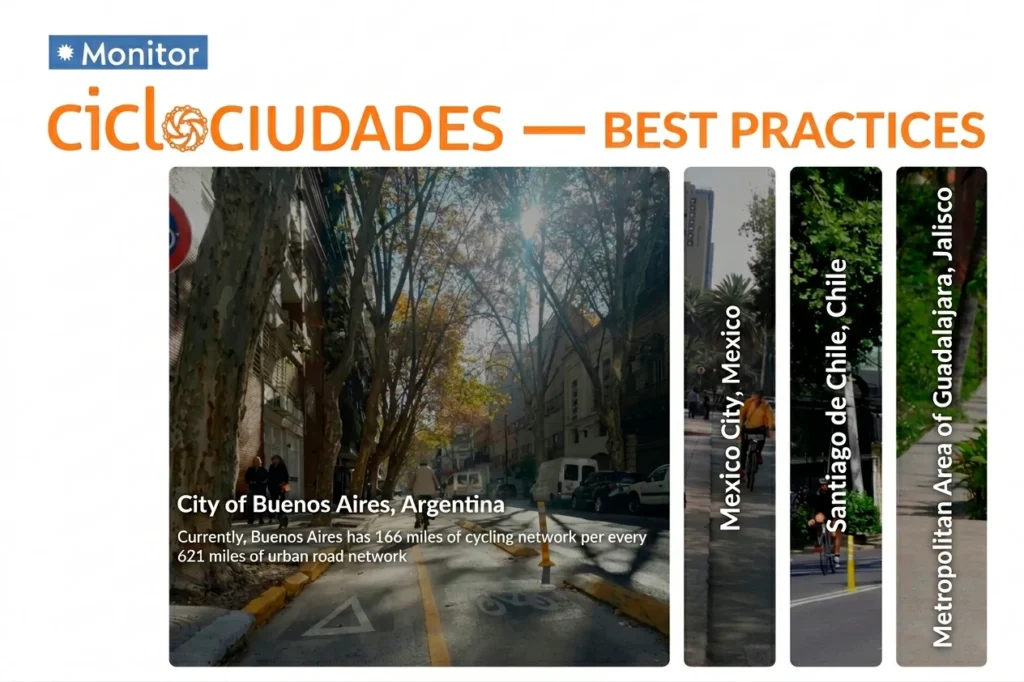
For the Monitor Ciclociudades 2025 Program, ITDP provided both an online form and an email registration process that enabled cities from across the region to participate. In total, 43 registrations were received from Latin America, of which 26 entities actively completed the process. Participating cities represented countries such as Mexico, Chile, Argentina, and Colombia, reinforcing the program’s regional scope and comparative value.
One of the key features of the study is the inclusion of civil society perspectives. Cycling advocacy groups continue to report persistent challenges, including bike lane encroachment, poor connectivity between cycling corridors, and a lack of incentives in workplaces and educational institutions. These findings reveal a gap between official data and the daily experiences of cyclists, highlighting the importance of incorporating citizen voices into the evaluation of cycling mobility.
Beyond The Data Lies a Deeper Understanding of Cycling Mobility
More than just figures, the project provides a solid foundation for advancing urban discussions. In fact, those interested in how high‑quality cycling infrastructure can reshape cities will benefit from complementary studies showcasing success stories in Mexico and abroad. These examples indeed illustrate what is achievable when proper planning is in place.
Similarly, anyone interested in exploring the design and rationale of bikeways will benefit from specialized resources such as the Urban Bikeway Design Guide. Indeed, these materials broaden perspectives and demonstrate how technical principles shape both safety and the everyday usability of these spaces.
What Does This Project Contribute?
The legacy of this effort is not a set of closed answers or one‑size‑fits‑all solutions. Its value lies in organizing information, making progress visible, and clearly pointing out pending challenges. Moreover, in a diverse region like Latin America, having such tools is essential for informed decision‑making and for advancing toward cities where bicycles hold a clear place in everyday mobility.