

In a world where motorized transportation dominates the streets, it may be surprising—especially if you live in Latin America—to learn that there are more than one billion bicycles worldwide, roughly as many as passenger cars. With this in mind, it is worth asking which countries have the most bicycles per capita.
Throughout our cycling journeys, we have explored everything from the best bike lanes in the world, the most beautiful bike lanes in different countries, and those powered by cutting-edge technology to routes that connect entire countries.
The development of cycling infrastructure may be closely related to the number of people who use bicycles as a means of transportation. After all, the more cyclists there are, the greater the need for safe and accessible routes. As a result, countries with high rates of bicycle use may also have more extensive cycling infrastructure.
So, let’s find out which countries have the most bicycles per capita. Grab your bike repair kit and join us on this ride around the world!
Countries With the Most Bicycles per Capita: Is Yours on the List?
Belgium
It is no surprise that a country where cycling is a national sport would appear on this list. Belgium has a population of 10,827,519 and approximately 5,200,000 bicycles. This means that about 48% of the population owns a bicycle.
Additionally, 8% of daily trips are made by bicycle. On average, each citizen travels about 0.621 miles per day on two wheels.

Switzerland
If cycling through the city is enjoyable, riding through breathtaking natural landscapes is even better. In Switzerland, people can enjoy both on a daily basis, perhaps explaining why 49.4% of the population owns a bicycle.
The country has 8,000,000 of citizens with a total of 3,950,000 bicycles. Likewise, is estimated that the 10% of their total journeys is performed with this vehicle.

Japan
If the previous figures have not surprised you yet, Japan will surely leave you amazed. In fact, in the Land of the Rising Sun, 72,540,000 people own a bicycle, representing more than half of the country’s total population of 127,370,000. As a result, Japan stands out as a key market for cycling mobility and safer bicycle infrastructure.
In fact, 56.9% of Japan citizens own a bicycle. For this reason, more than 10 million bicycles are sold in the country every year. Additionally, 15% of commuting trips are made by bicycle, so train stations are fully equipped with dedicated bicycle parking and storage areas. Undoubtedly, Japan is one of the countries with the highest number of bicycles per capita, making a safe cycling infrastructure increasingly important for everyday mobility.

Finland
With a population of 5,380,200, Finland may not compare with Japan’s more than 70 million residents. However, that does not mean cycling is any less popular. The country has approximately 3,250,000 bicycles, meaning that 60.4% if its population owns a bike. Moreover, bicycles account for 9% of daily trips, highlighing Finland’s strong cycling culture and the importance of safe, well-planned cycling infrastructure.

Norway
Just above Finland, another country that can boast millions of bicycles for its millions of residents is Norway. In the land of the Northern Lights, there are 3,010,000 bicycles for a population of 4,945,000 people. However, in this case, only 4% of trips are made by bicycle, a considerable lower share than in neighboring Finland. Even so, Norway’s high bicycle-to-population ratio highlights the continued presence of cycling within the country’s transportation landscape.

Sweden
Although the percentages among these countries are not too different, the numbers will make the top spot even more surprising when we reveal which country leads the ranking for bicycles per capita.
Meanwhile, Sweden is not far behind the previous two countries. Often considered one of the world’s least stressful countries, perhaps its stron cycling culture plays a role: 6,250,000 o its 9,450,000 residents own a bicycle. As a result, 8% of all trips are made by this sustainable transport mode, highlighting the importance of safe and accessible cycling infrastructure.

Germany
From this point on, the numbers take a major leap. Germany, with a population of 82,000,000, is estimated to have 62,700,000 people who own a bicycle. In percentage terms, that means approximately 76% of Germans have a bike. Moreover, bicycles account for 9% of daily trips, highlighting the country’s strong cycling culture and the growing importance of safe, accessible bike lanes.

Denmark
Ready for the first surprise? Happiness may very well ride on two wheels. Why do we say that? Denmark is widely known as one of the world’s happiest countries, and perhaps it is no coincidence that 80% of its population owns a bicycle. With 4,700,000 bicycles among 5,750,000 residents, cycling is clearly part of everyday life.
Surprisingly, 18% of daily trips are made by bicycle. In addition the Danish government has introduced several bike-sharing and bicycle loan programs to encourage more people to cycle. Clearly, Denmark has a goal in mind: making cycling an increasingly common choice for everyday transportation.

Netherlands
Ready to fall out of your seat? We are sure you are not prepared for this fact: The Netherlands has more than earned its place at the top of the list of countries with the mos bicycles per capita. How many residents do you think own a bike? Well, the country has 16,500,000 bicycles for a population fo16,690,000.
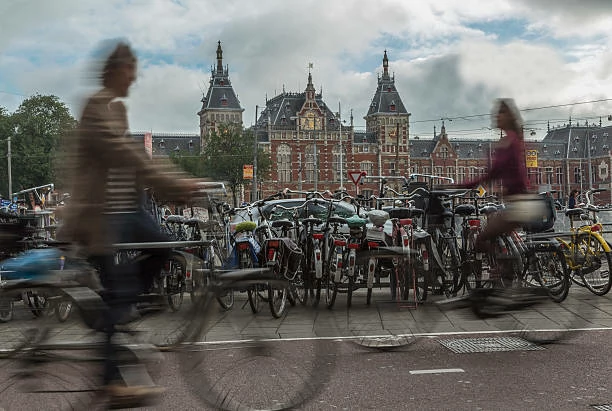
That means approximately 99% of the population has a bicycle. In other words, almost everyone in the country can ride a bike for transportation. Amazing, right? Moreover, the Netherlands is one of the world’s most bike-friendly countries. Its capital, Amsterdam, has 248 miles of bike lanes and paths, allowing approximately 50% of journeys to be made by bicycle, including trips to work.

China
To wrap up the list, here is an interesting fact: although the Netherlands has the highest number of bicycles per capita, it is not the country with the most bicycles overall.
This record belongs to China, which has approximately 500,000,000 bicycles for a population of 1,412,506,800 people. However, this means that bicycles account for transportation for approximately 37.2% of the population.